ISLAND FARM
PRISONER OF WAR CAMP: 198 / Special Camp: XI
Bridgend, South Wales.
On the night of 10th-11th March 1945, Seventy German prisoners tunnelled to freedom from Camp 198 in Bridgend. It was the biggest escape attempt made by German P.O.W.s in Great Britain during the Second World War.

Main entrance of the Island Farm Special Camp 11 - 1948
Click to enlarge image.

Derelict Island Farm Camp (early 1980s)
Email me about this website: Brett Exton
| Sign website: Guest Book
Join my Island Farm History Group on: Facebook
Join my Island Farm History Group on: Facebook
Island Farm Originated
1938
American Units
October 1943
February 1944 (28th Infantry Division)
April 1944 (2nd Infantry Division)
May 1944
September 1944
Island Farm - Low Ranking - Camp 198
The Big Escape
Island Farm - High Ranking - Special Camp 11
THE HIGH RANKING GERMAN OFFICERS HELD
 The above POWs were those identified when I initially created
this web site. The list is now far more extensive:
The above POWs were those identified when I initially created
this web site. The list is now far more extensive:CLICK HERE TO SEE OVER 200 ADDITIONAL POWs HELD AT ISLAND FARM
This is a second web page I host.
The Unidentified German Officers - Can you help ?
Life On The Otherside of the Wire / British Guards
Miscellaneous
German PoW Orderlies to the High ranking German Officers
Aufwiedersehen - Repatriation
Closure Of Special Camp 11
Modern Day News / Photos
Royal Ordnance Factory 53 Bridgend
Air-Raids On South Wales
Other POW Camps In Great Britain
Tips On How To Find Information
Website & Hut 9 Under Attack!
60th Anniversary of D-Day
TV Programmes
IMPORTANT PLEASE NOTE THE ERRORS MADE IN: The Welsh Great Escape:
1) Island Farm was a "white camp" (not black).
2) Otto Iskat died of high blood pressure (not a beating). See Death Certificate.
3) Tunnel was 30 feet, not 60 feet.
4) Escapees were low-rank POWs, not officers.
5) Actual escape figure was 70 POWs.
1) Island Farm was a "white camp" (not black).
2) Otto Iskat died of high blood pressure (not a beating). See Death Certificate.
3) Tunnel was 30 feet, not 60 feet.
4) Escapees were low-rank POWs, not officers.
5) Actual escape figure was 70 POWs.
Tell Me What You Think Of This Site
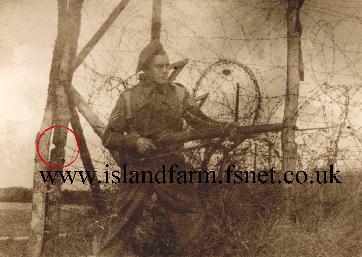
Sgt William Ronald Williams guarding the fence in 1946. Note: Red circle shows where PoWs attempted to saw through the fence post.
Disclaimer: The preservation of Hut 9 and this web site is dedicated to history and research. This site is not about the politics of Nazism. It is through honest, objective research that one may understand the plight of millions during WWII.