DARK DAYS OF THE 28TH DIVISION.
A very sad hand written letter from an American deserter
Pvt Edward Donald Slovik (18th February 1920 - 31st January 1945)
EXECUTED FOR DISERTION
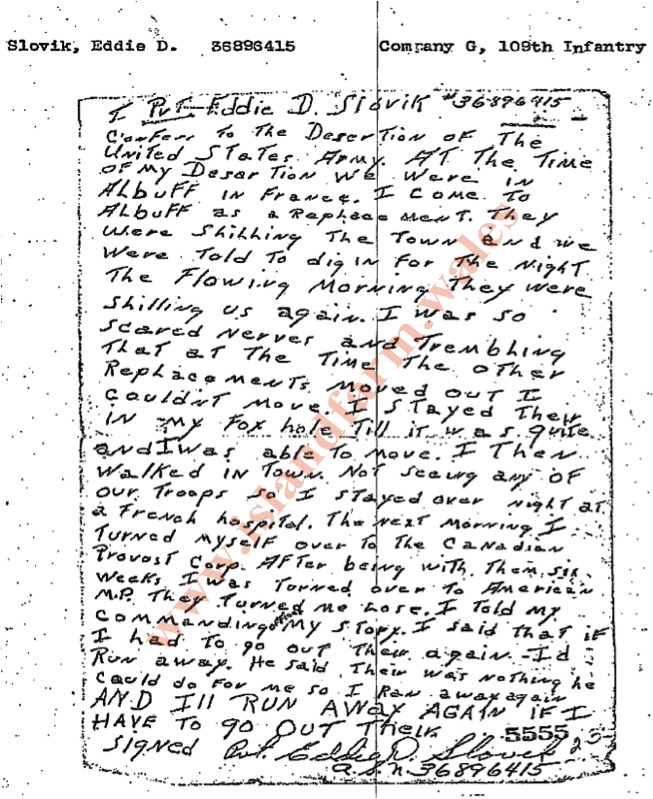
Slovik Eddie D. 36896415 Company G 109th Infantry
I Pvt Eddie D Slovik
36896415
confess to the desertion of the
United States Army. At the time
of my desertion we were in
Albuff in France. I come to
Albuff as a replacement. They
were shelling [sic] the town and we
were told to dig in for the night.
The flowing[sic] morning they were
shilling[sic] us again. I was so
scared nerves and tembling
that at the time the other
replacements moved out I
couldnt move. I stayed their[sic]
in my fox hole till it was quite[sic]
and I was able to move. I then
walked in town not seeing any of
our troops so I stayed over night at
a French hospital. The next morning I
turned myself over to the Canadian
Provost Corp. After being with them six
weeks I was turned over to American
M.P. they turned me lose[sic]. I told my
commanding officer my story. I said that if
I had to go out their[sic] again I'd
run away. He said their[sic] was nothing he
could do for me so I ran away again
AND I'LL RUN AWAY AGAIN IF I
HAVE TO GO OUT THERE[sic]
Signed Pvt Eddie
D Slovik
Edward Donald Slovik was the only American soldier to be court-martialled and executed for desertion since the American Civil War. Although over 21,000 American soldiers were given varying sentences for desertion during World War II, including forty-nine death sentences, Slovik's death sentence was the only one that was carried out.
The execution by firing
squad was carried out at 10:04 a.m. on January 31, 1945, near the village of
Sainte-Marie-aux-Mines. The unrepentant Slovik said to the soldiers whose duty
it was to prepare him for the firing squad before they led him to the place
of execution: "They're not shooting me for deserting the United States Army,
thousands of guys have done that. They just need to make an example out of somebody
and I'm it because I'm an ex-con. I used to steal things when I was a kid, and
that's what they are shooting me for. They're shooting me for the bread and
chewing gum I stole when I was 12 years old."
As required by military custom, Slovik's uniform was stripped of all military
identifying insignia, buttons or any other accoutrements and wrapped with a
GI blanket over his shoulders to protect him against the cold, he was led into
the courtyard of a house chosen for the execution because of its high masonry
wall to deflect errant bullets and to discourage the local French civilians
from witnessing the solemn proceedings. Soldiers stood him against a six inch
by six inch post. He was then strapped to the post with web belts, with one
wrapped around and under his arms and hung on a spike on the back side of the
post to prevent his body from slumping following the volley, and the others
securing his knees and ankles. Just before a soldier placed a black hood over
his head, the attending chaplain, Father Carl Patrick Cummings, said to Slovik,
"Eddie, when you get up there, say a little prayer for me." Slovik replied with
his last words: "Okay, Father. I'll pray that you don't follow me too soon."
Twelve hand-picked soldiers were detailed for the firing squad from the 109th
Regiment. The weapons used were standard issue M1 Garand rifles with just one
round loaded in eleven rifles and one rifle loaded with a blank round.[11] On
the command of "Fire", Slovik was hit by eleven bullets, at least four of them
being fatal. The wounds ranged from high in the neck region out to the left
shoulder, over the left chest, and under the heart. One bullet was in the left
upper arm. An Army physician quickly determined Slovik had not been immediately
killed. As the firing squad's rifles were being reloaded to fire another volley,
Slovik expired. He was 24 years old. The entire execution took 15 minutes.
Slovik was buried in Plot E of Oise-Aisne American Cemetery and Memorial , alongside
95 American soldiers executed for rape or murder. Their grave markers are hidden
from view by shrubbery and bear sequential numbers instead of names, making
it impossible to identify them individually without knowing the key. Antoinette
Slovik petitioned the Army for her husband's remains and his pension until her
death in 1979. Slovik's case was taken up in 1981 by former Macomb County Commissioner
Bernard V. Calka, a Polish-American World War II veteran, who continued to petition
the Army to return Slovik's remains to the United States. In 1987, he persuaded
President Ronald Reagan to order their return.
In 1987, Calka raised $5,000
to pay for the exhumation of Slovik's remains from Row 3, Grave 65 of Plot E
and their transfer to Detroit's Woodmere Cemetery, where Slovik was reburied
next to his wife.
Antoinette Slovik and others had petitioned seven US presidents (Harry S. Truman,
Dwight D. Eisenhower, John F. Kennedy, Lyndon B. Johnson, Richard Nixon, Gerald
Ford, and Jimmy Carter) for a pardon, but none were granted.