28TH INFANTRY DIVISION
Brief history:
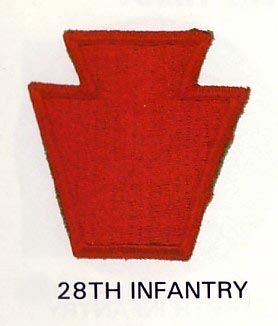
The red "keystone",
official emblem of the State of Pennsylvania,
is the insignia of the 28th Division, which was originally a Pennsylvania
National Guard organisation.
The Germans called it the " Bloody Bucket " because of the blood-red keystone and their fighting tactics.
In the initial years (2000) of this web site research, I tried to identify who the Americans were that were stationed at Island Farm and spoke to quite a few American Veterans. However, the answer remained a mystery until 2003 when I received the following email:
"General Eisenhower reviewed the American troops who were stationed in Porthcawl on 1 April 1944. The 107th Field Artillery Battalion, part of the 28th Infantry Division, was accommodated in Porthcawl from 17 October 1943 until 13 April 1944, when it moved out to Tidworth, Hampshire, and then joined their landing craft in Weymouth en route for Omaha beach. Eisenhower's inspection was carried out at Newton Burrows, grass covered sandhills five minutes south of where I live and where there was a firing range used by the troops. The targets are still there in the pits, as are the firing trenches. Eisenhower is also recorded to have addressed members of the 28th Division who were billeted at Margam Castle, which is six or seven miles to the west of Porthcawl. "
The above email told me that it was the 28th Infantry Division that had been stationed in the Bridgend area and following enquiries on this lead, I was then fortunate to receive the following email:"
"The 28th Infantry Division history says that on 1 April 1944, General Eisenhower inspected units of the division. There is photo which shows Eisenhower addressing soldiers at Margam Castle, Port Talbot. These would have been soldiers of the 109th Infantry Regiment. The period the 28th spent in Wales was the longest period they were in any place during the war. Following the war there were a number of marriages as a result. Our crude estimate is roughly 350 such unions. Island Farm was the location of the 2nd battalion of the 109th Infantry Regiment. (Margam Castle was the location of the 109th Infantry Regimental Headquarters, the 1st Battalion 109th and Service Company). Sincerely, William O. Hickok"
109th STATIONED AT ISLAND FARM

The distinctive insignia of the 109th Infantry
Regiment.
The regimental motto
"Cives Arma Ferant" - "Let the Citizens Bear Arms."
With the information contained in the email above it was now possible to visualise the battalion which was at Island Farm and to explain this I have written the following:
The 28th Infantry Division was made up of Division HQ and 3 Infantry Regiments:
- Division - HQ
- 109th Infantry Regiment
- 110th Infantry Regiment
- 112th Infantry Regiment
Each regiment was made up of a Regimental HQ and 3 Battalions.
- 109th Infantry Regiment
- Regimental HQ - based at Margam Castle
- 1st Battalion
- 2nd Battalion
- 3rd Battalion
- 110th Infantry Regiment
- Regimental HQ
- 1st Battalion
- 2nd Battalion
- 3rd Battalion
- 112th Infantry Regiment
- Regimental HQ
- 1st Battalion
- 2nd Battalion
- 3rd Battalion
Each battalion was made up of Battalion HQ company and 4 companies..
- 1st Battalion
- 1st Battalion HHC (Headquarters and Headquarters Company)
- A (Able) Rifle Company
- B (Baker) Rifle Company
- C (Charlie) Rifle Company
- D (Dog) Heavy Weapons Company (armed with machine guns and 81mm mortars to support the rifle companies)
- 2nd Battalion
- 2nd Battalion HQ
- E (Easy) Rifle Company
- F (Fox) Rifle Company
- G (George) Rifle Company
- H (How) Heavy Weapons Company (armed with machine guns and 81mm mortars to support the rifle companies)
- 3rd Battalion - based at Porthcawl.
- 3rd Battalion HHC (Headquarters and Headquarters Company)
- I (Item) Rifle Company
- K (King) Rifle Company
- L (Love) Rifle Company
- M (Mike) Heavy Weapons Company (armed with machine guns and 81mm mortars to support the rifle companies)
The U.S. Army jumped directly from Company I to Company K. (missing out J)
There are two main reasons for this:
- Visual Confusion In the 1940s, military documents were often typed on manual typewriters or handwritten in the field. The capital letter "J" was considered too easy to confuse with the capital letter "I" (for Item) or the number "1". To prevent a commander from accidentally sending an entire company to the wrong location due to a typo or a smudge on a carbon copy, the Army simply removed "J" from the alphabet.
- Phonetic Clarity When communicating over a radio (which was notoriously "crackly" in WWII), the phonetic alphabet was used. Even though the WWII phonetic for I was "Item" and J was "Jig," the Army decided that having three companies starting with similar visual or phonetic profiles (I, J, K) was a risk not worth taking. The "Missing" Company in the 3rd Battalion Because of this rule, the 3rd Battalion of the 109th Infantry (and every other infantry regiment) was organized as follows: Company I (Item) Company K (King) Company L (Love) Company M (Mike Note: The WWII era U.S. phonetic alphabet was replaced in the late 1950s by new words which are still used today. For example:
- Previously: A=Able, B=Baker, C=Charlie, D=Dog, E=Easy, F=Fox, G=George, H=How, I =Item, K=King,
L=Love, M=Mike etc
Today: A=Alpha, B=Bravo, C=Charlie, D=Delta, E=Echo, F=Foxtrot, G=Golf, H=Hotel, I=Indigo, K=Kilo, L=Lima, M-Mike etc
Just to add to the confusion...
MEDICAL - When the regiments were committed, each regiment had a medical battalion attached for combat operations. In this case, 109th Infantry Regiment, it was the 103rd medical battalion.
- 103rd Medical Battalion, "Able" Medical Company with the 109th Infantry Regiment
- 103rd Medical Battalion, "Baker" Medical Company with the 110th Infantry Regiment
- 103rd Medical Battalion, "Charlie" Medical Company with 112th Infantry Regiment.
As with any other combat support units, the same company was always attached to the same regiment.
- Division HQ
- 109th Infantry Regiment:
- HQ Regiment - Based at Margam Castle
- 1st Battalion:
- 1st Battalion HHC (Headquarters and Headquarters Company)
- A (Able) Rifle Company
- B (Baker) Rifle Company
- C (Charlie) Rifle Company
- D (Dog) Heavy Weapons Company (armed with machine guns and 81mm mortars to support the rifle companies)
- 2nd Battalion:
- 2nd Battalion HHC (Headquarters and Headquarters Company) - Based at Island Farm
- E (Easy) Rifle Company
- F (Fox) Rifle Company - Based at Island Farm
- G (George) Rifle Company
- H (How) Heavy Weapons Company (armed with machine guns and 81mm mortars to support the rifle companies)
- 3rd Battalion:
- 3rd Battalion HHC (Headquarters and Headquarters Company)
- I (Item) Rifle Company
- K (King) Rifle Company
- L (Love) Rifle Company
- M (Mike) Heavy Weapons Company (armed with machine guns and 81mm mortars to support the rifle companies)
- Supported by: 107th Field Artillery Battalion:
- 107th Field Artillery Battalion HHC
- Headquarters Battalion / Battery (Hq)
- Battery A: 4 x 105mm Howitzers.
- Battery B: 4 x 105mm Howitzers.
- Battery C: 4 x 105mm Howitzers. Service Battery: Managed the
lorries, ammunition supply, and vehicle maintenance
- 103rd Medical Battalion ABLE Company
- 110th Infantry Regiment:
- HQ Regiment
- 1st Battalion:
- 1st Battalion HHC (Headquarters and Headquarters Company)
- A (Able) Rifle Company
- B (Baker) Rifle Company
- C (Charlie) Rifle Company
- D (Dog) Heavy Weapons Company (armed with machine guns and 81mm mortars to support the rifle companies)
- 2nd Battalion:
- 2nd Battalion HHC (Headquarters and Headquarters Company)
- E (Easy) Rifle Company
- F (Fox) Rifle Company
- G (George) Rifle Company
- H (How) Heavy Weapons Company (armed with machine guns and 81mm mortars to support the rifle companies)
- 3rd Battalion:
- 3rd Battalion HHC (Headquarters and Headquarters Company)
- I (Item) Rifle Company
- K (King) Rifle Company
- L (Love) Rifle Company
- M (Mike) Heavy Weapons Company (armed with machine guns and 81mm mortars to support the rifle companies)
- Supported by: 109th Field Artillery Battalion:
- Headquarters Battalion / Battery (Hq)
- Battery A: 4 x 105mm Howitzers.
- Battery B: 4 x 105mm Howitzers.
- Battery C: 4 x 105mm Howitzers.
- Service Battery: Managed the lorries, ammunition supply, and vehicle maintenance.
- 103rd Medical Battalion BAKER Company
- 112th Infantry Regiment:
- HQ Regiment
- 1st Battalion:
- 1st Battalion HHC (Headquarters and Headquarters Company)
- A (Able) Rifle Company
- B (Baker) Rifle Company
- C (Charlie) Rifle Company
- D (Dog) Heavy Weapons Company (armed with machine guns and 81mm mortars to support the rifle companies)
- 2nd Battalion:
- 2nd Battalion HHC (Headquarters and Headquarters Company)
- E (Easy) Rifle Company
- F (Fox) Rifle Company
- G (George) Rifle Company
- H (How) Heavy Weapons Company (armed with machine guns and 81mm mortars to support the rifle companies)
- 3rd Battalion:
- 3rd Battalion HHC (Headquarters and Headquarters Company)
- I (Item) Rifle Company
- K (King) Rifle Company
- L (Love) Rifle Company
- M (Mike) Heavy Weapons Company (armed with machine guns and 81mm mortars to support the rifle companies)
- Supported by: 229th Field Artillery Battalion:
- Headquarters Battalion / Battery (Hq)
- Battery A: 4 x 105mm Howitzers.
- Battery B: 4 x 105mm Howitzers.
- Battery C: 4 x 105mm Howitzers.
- Service Battery: Managed the lorries, ammunition supply, and vehicle maintenance.
- 103rd Medical Battalion CHARLIE Company
- 108th Field Artillery Battalion - Based at
Island Farm
- Headquarters Battalion
- Headquarters Battery
- Battery A: 4 x 155mm Howitzers.
- Battery B: 4 x 155mm Howitzers.
- Battery C: 4 x 155mm Howitzers.
- Service Battery: The "muscle" and logistics. They ran the M5 Tractors and brought the 95lb shells forward to the guns.
The 108th supported entire Division as a whole providing reinforcing fire. This battalion was armed with 155 mm howitzers. Therefore, it was not paired with an Infantry Regiment
Shell Weight: Each high-explosive shell weighed about 43 kg (95 lbs which is 6.8 Stone ! ). Range: It could hit targets over 14 kilometres (approx. 9 miles) away.
Transport: These guns were too heavy to be pulled by horses or light trucks; they were towed by massive M5 or M4 high-speed tractors (often called "Prime Movers").
- 28th Reconnaissance Troop, Mechanized
- 28th Counter Intelligence Corps Detachment
- Headquarters Special Troops
- Military Police Platoon
- 728th Ordnance Light Maintenance Company
- 28th Quartermaster Company
- 28th Signal Company
Others...